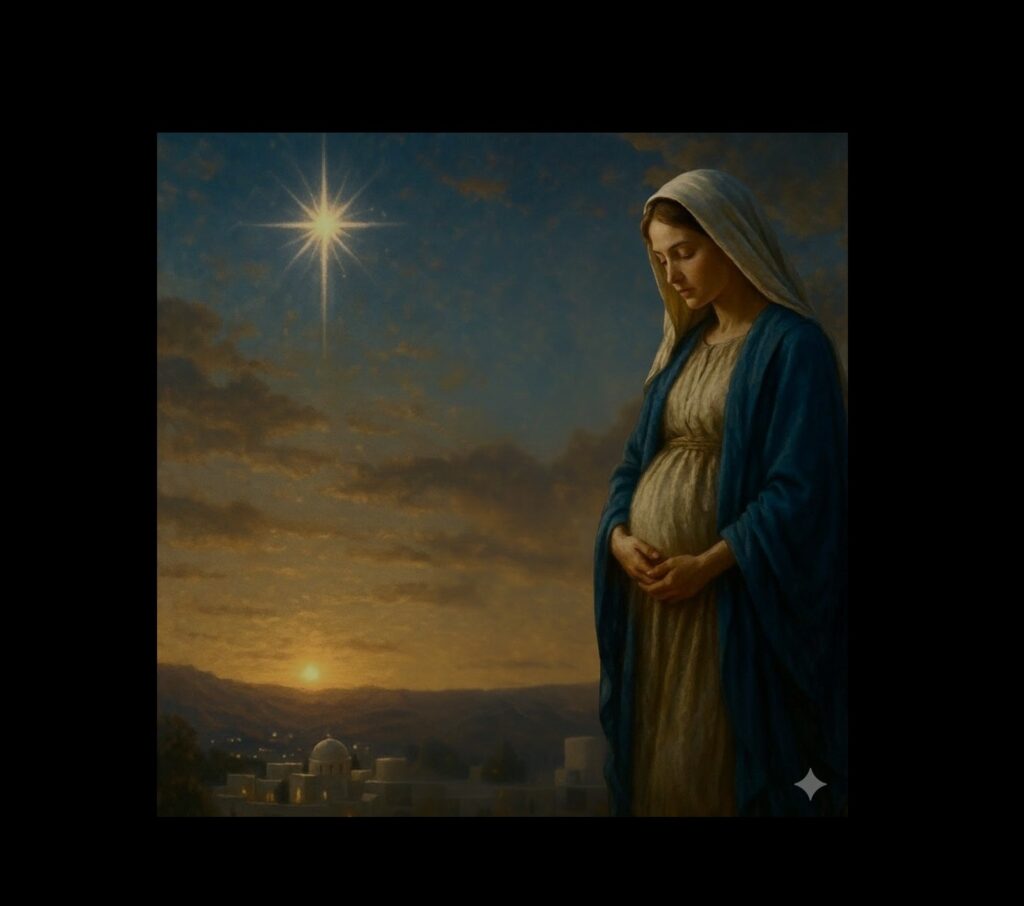

Mark your calendar. The Advent Rorate candlelight Mass in honor of Our Lady will be at 6:00 a.m. this Saturday,
December 13. This link has the text of the Rorate Mass Propers along with lyrics and video of the Rorate chant and an explanation on the history of this beautiful Mass.
CATHOLIC ENCYCLOPEDIA – Rorate Coeli
http://www.newadvent.org/cathen/13183b.htm
(Vulgate, text), the opening words of Isaiah 45:8. The text is used frequently both at Mass and in the Divine Office during Advent, as it gives exquisite poetical expression to the longings of Patriarchs and Prophets, and symbolically of the Church, for the coming of the Messias. Throughout Advent it occurs daily as the versicle and response at Vespers. For this purpose the verse is divided into the versicle, “Rorate coeli desuper et nubes pluant justum” (Drop down dew, ye heavens, from above, and let the clouds rain the just), and the response: “Aperiatur terra et germinet salvatorem” (Let the earth be opened and send forth a Saviour”). The text is also used: (a) as the Introit for the Fourth Sunday in Advent, for Wednesday in Ember Week, for the feast of the Expectation of the Blessed Virgin, and for votive Masses of the Blessed Virgin during Advent; (b) as a versicle in the first responsory of Tuesday in the first week of Advent; (c) as the first antiphon at Lauds for the Tuesday preceding Christmas and the second antiphon at Matins of the Expectation of the Blessed Virgin; (d) in the second responsory for Friday of the third week of Advent and in the fifth responsory in Matins of the Expectation of the Blessed Virgin. In the “Book of Hymns” (Edinburgh, 1910), p. 4, W. Rooke-Ley translates the text in connection with the O Antiphons:
Mystic dew from Heaven
Unto earth is given:
Break, O earth, a Saviour yield —
Fairest flower of the field.
The exquisite Introit plain-song may be found in in the various editions of the Vatican Graduale and the Solesmes “Liber Usualis”, 1908, p. 125. Under the heading, “Prayer of the Churches of France during Advent”, Dom Guéranger (Liturgical Year, Advent tr., Dublin, 1870, pp. 155-6) gives it as an antiphon to each of a series of prayers (“Ne irascaris”, “Peccavimus”, “Vide Domine”, “Consolamini”) expressive of penitence, expectation, comfort, and furnishes the Latin text and an English rendering of the Prayer. The Latin text and a different English rendering are also given in the Baltimore “Manual of Prayers” (pp. 603-4). A plain-song setting of the “Prayer”, or series of prayers, is given in the Solesmes “Manual of Gregorian Chant” (Rome-Tournai, 1903, 313-5) in plain-song notation, and in a slightly simpler form in modern notation in the “Roman Hymnal” (New York, 1884, pp. 140-3), as also in “Les principaux chants liturgiques” (Paris, 1875, pp. 111-2) and ‘IRecueil d’anciens et de nouveaux cantiques notés” (Paris, 1886, pp. 218-9).
From the Saint Andrew Daily Missal:
With sighs of longing Isaias foretells the deliverance of Israel. By means of metaphors taken from nature he compares this deliverance to a precious seed committed to the soil to be made fertile by rain and dew. This fertile soil, saturated with blessings, is Mary; our Lord Himself is the blessed fruit which springs from this virgin soil.
The verse is a Messianc psalm in which David enlarges upon the metaphor employed by Isaias.
The heavens show forth the glory of the Lord, for Christ, the divine Sun is soon to come, like a giant to run his course, and nothing will escape His light and His fiery heat (Psalm 8, 3, 5, 6).
English lyrics:
Drop down dew, ye heavens, from above, and let the clouds rain the Just One.
Be not angry, O Lord, and remember no longer our iniquity : behold the city of Thy sanctuary is become a desert, Sion is made a desert. Jerusalem is desolate, the house of our holiness and of Thy glory, where our fathers praised Thee.
Drop down dew, ye heavens, from above, and let the clouds rain the Just One.
We have sinned, and we are become as one unclean, and we have all fallen as a leaf; and our iniquities, like the wind, have taken us away Thou hast hid Thy face from us, and hast crushed us by the hand of our iniquity.
Drop down dew, ye heavens, from above, and let the clouds rain the Just One.
See, O Lord, the affliction of Thy people, and send Him whom Thou hast promised to send. Send forth the Lamb, the ruler of the earth, from the rock of the desert to the mount of the daughter of Sion, that He Himself may take off the yoke of our captivity.
Drop down dew, ye heavens, from above, and let the clouds rain the Just One.
Be comforted, be comforted, My people; thy salvation shall speedily come. Why wilt thou waste away in sadness? why hath sorrow seized thee? I will save thee; fear not: for I am the Lord thy God, the Holy One of Israel, thy Redeemer.
Drop down dew, ye heavens, from above, and let the clouds rain the Just One.
Latin lyrics:
Rorate caeli desuper, et nubes pluant iustum.
Ne irascaris Domine, ne ultra memineris iniquitatis: ecce civitas Sancti facta est deserta: Sion deserta facta est: Jerusalem desolata est: domus sanctificationis tuae et gloriae tuae, ubi laudaverunt te patres nostri.
Rorate caeli desuper, et nubes pluant iustum.
Peccavimus, et facti sumus tamquam immundus nos, et cecidimus quasi folium universi: et iniquitates nostrae quasi ventus abstulerunt nos: abscondisti faciem tuam a nobis, et allisisti nos in manu iniquitatis nostrae.
Rorate caeli desuper, et nubes pluant iustum.
Vide Domine afflictionem populi tui, et mitte quem missurus es: emitte Agnum dominatorem terrae, de Petra deserti ad montem filiae Sion: ut auferat ipse iugum captivitatis nostrae.
Rorate caeli desuper, et nubes pluant iustum.
Consolamini, consolamini, popule meus: cito veniet salus tua: quare maerore consumeris, quia innovavit te dolor? Salvabo te, noli timere, ego enim sum Dominus Deus tuus, Sanctus Israel, Redemptor tuus.
Rorate caeli desuper, et nubes pluant iustum.